
AI Copywriting vs Human Writers: Cost, Quality, and When to Use Each
Opening: Why this comparison matters for busy business owners
If you run a small business or are a solo entrepreneur, maintaining a consistent blog is often the single most reliable long-term tactic to grow organic traffic — but it’s also time-consuming and expensive. The rise of AI tools promises faster output at lower cost, while traditional human writers promise nuance and conversion-focused creativity. This article compares AI copywriting and human writing across speed, cost-per-article, conversion impact, and SEO performance so you can decide which approach (or combination) fits your content strategy. Examples and recommendations factor in practical realities for business owners Worldwide.
What we mean by AI copywriting and human writing
AI copywriting refers to content produced (or drafted) by natural language models and specialist tools designed for marketing content. Outputs range from short product descriptions to full long-form articles; quality depends heavily on prompts, tool configuration, and human review. An ai copywriter pros and cons analysis recognizes that while AI increases throughput, it can introduce inaccuracies or flat tone without editing.

Human writing refers to content created by professional writers, journalists, or marketers. Humans bring research, brand voice, and empathy; they can run interviews, synthesize complex topics, and craft persuasive messaging tuned to conversion goals.
Speed & scalability: How fast can you publish?
Turnaround times
AI: A modern AI content platform can produce a first draft in minutes. For example, a 1,000-word SEO draft can often be generated in under 10 minutes; additional time for review and optimization varies. This makes AI well-suited when you need volume — multiple posts per week or month — without hiring an in-house writer.
Humans: A freelance or agency writer typically takes 1–7 days for a polished 800–1,500 word article, depending on research needed. Complex technical topics or interviews extend timelines.
Scalability and consistency
- AI advantage: Produces consistent output at scale with predictable throughput (e.g., dozens of articles per month).
- Human advantage: Consistency of voice and strategic alignment when a dedicated author produces most pieces.
Cost-per-article & economic comparison
Cost is often the deciding factor for small businesses. Let’s look at typical ranges and the effective per-article cost when using AI platforms like AiBlogPress versus hiring humans.

Typical cost ranges
- AI tools: Subscription-based. Low-tier plans: $20–$50/month; mid-tier: $60–$200/month; enterprise: $200+/month. If you generate 20–40 articles monthly the effective cost per article (tool only) can be as low as $1–$10.
- Freelance writers: $50–$500+ per article depending on length, niche expertise, and conversion skill. A reliable mid-level SEO writer often charges $150–$300 for 1,000–1,500 words.
- Agencies: $500–$2,000+ per article for strategic briefs, editing, and optimization.
True total cost: editing, SEO, publishing
Don’t forget the downstream costs. With AI, add editing time (in-house or outsourced), SEO optimization, image creation, and publishing. AiBlogPress reduces those costs by automating SEO optimization, featured images, and WordPress publishing — shrinking operational overhead. For human-produced content, you may still need CMS posting or image sourcing, but high-quality writers often deliver near-publish-ready content.
Example cost model (monthly)
Business A needs 12 posts/month (1,000 words each):
- AI route (AiBlogPress): $99/month subscription, minimal editing (5 hours/month at $25/hr) = ~$224/month, ~ $19/article.
- Freelance writers: 12 articles x $200 = $2,400/month; light publishing support could add $100–$300.
Numbers vary by market, but this shows how AI dramatically reduces recurring content budget for volume-focused strategies.
Quality, conversion impact, and SEO performance
Quality and persuasive copy
Human writers typically outperform AI on high-stakes, conversion-driven pages (sales pages, long-form case studies, brand storytelling). Humans excel at persuasion, emotional nuance, and strategic framing that moves readers to action.
Vytvářejte SEO články na blog jako tento na autopilota.
Začít zdarma →AI is strong at drafting clear, information-dense content, product descriptions, and FAQs. When combined with human editing, AI drafts can reach conversion parity for many use cases.
Conversion impact — what the data suggests
Head-to-head A/B tests reported by marketers show mixed outcomes. For template-driven copy (e.g., ad headlines, meta descriptions, simple product pages), AI drafts can match or slightly outperform human copy after optimization. For complex conversion funnels and high-consideration products, human-crafted copy more often yields higher conversion lifts (commonly reported ranges: 5–25% improvement). The most reliable approach is to A/B test AI vs human content for your pages.
SEO performance: ranking, originality, and E-E-A-T
Search engines reward helpful, original, and authoritative content. AI-generated content can rank well if it delivers unique value, accurate information, and is optimized for search intent. However, there are common pitfalls:
- AI hallucinations or factual errors can harm usefulness and search trust.
- Generic, thin content lacks topical depth and may underperform on competitive queries.
- Search algorithms consider E-E-A-T (Experience, Expertise, Authoritativeness, Trustworthiness). Human authors with clear credentials typically score better on trust signals for YMYL (Your Money Your Life) topics.
Best practices: use AI to draft and outline, then apply human expertise for fact-checking, adding original insights, and linking to primary sources. Platforms like AiBlogPress automate technical SEO and publishing, but human oversight remains important for topical authority.
Use-case playbook: Which approach for which content type
To decide between AI copywriting and human writers, match the content type with the expected outcome and investment.
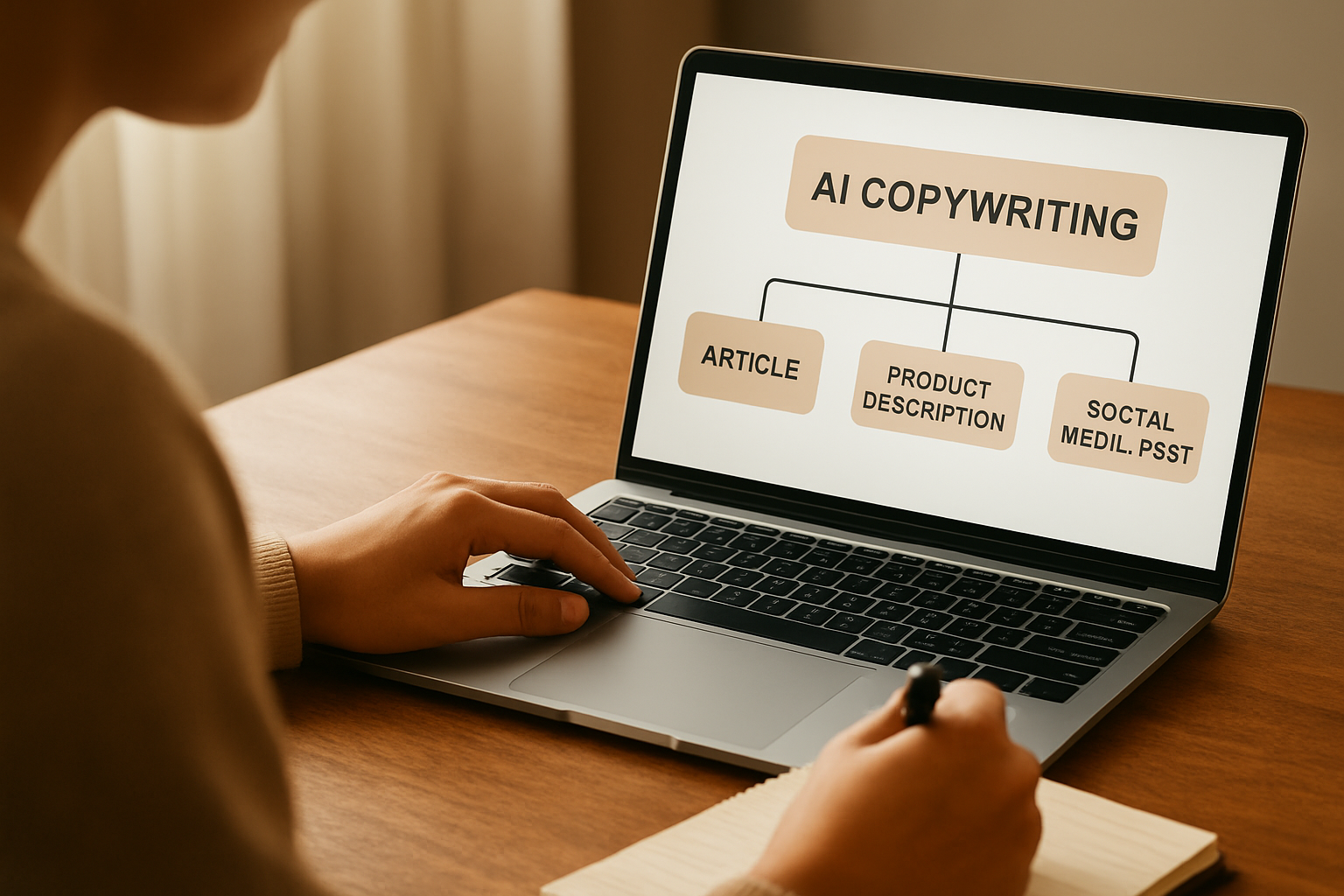
Use AI-first when:
- You need high volume of informational posts (how-tos, listicles, evergreen blog posts) to capture long-tail search traffic.
- You want rapid testing and iteration (publishing multiple variants quickly).
- Product descriptions, FAQs, and internal documentation where tone is functional.
- You have limited budget but need regular publishing — AiBlogPress’s automated pipeline is especially useful for solo entrepreneurs and small teams Worldwide.
Use human-first when:
- The page is mission-critical to revenue (sales pages, pricing pages, lead magnets).
- The topic requires domain expertise, interviews, or original reporting.
- You need brand voice consistency and long-term thought leadership.
Hybrid approach (recommended for most businesses)
Combine strengths: have AI generate outlines and first drafts; human writers or editors polish for voice, accuracy, and conversion. This hybrid workflow often delivers the best cost/quality balance: lower per-article cost than all-human, and much better conversion/authority than AI-only.
Managing risk: best practices and governance
Editorial process
- Implement a checklist for fact-checking, link verification, and brand voice.
- Use A/B testing to validate conversion outcomes for key pages.
- Monitor analytics and search rankings to identify content needing revision.
SEO safeguards
Avoid publishing AI drafts without review. Ensure each article provides unique value and correct facts. Optimize meta tags, structured data, and internal linking — tasks that AiBlogPress automates but should still be monitored.
Both technologies and human expertise are tools. The strategic question is not AI vs human — it’s how to apply each where they deliver the most value.
ai vs human copywriting: decision framework
Here’s a simple decision framework you can apply to any content brief:
Vytvářejte SEO články na blog jako tento na autopilota.
Začít zdarma →- Define the objective: traffic, leads, or revenue?
- Assess complexity: expert knowledge or straightforward information?
- Estimate value: what revenue or lifetime value does one page influence?
- Choose delivery: AI draft + human edit for mid-value; human-first for high-value; AI-only for low-cost informational volume.
This practical logic helps allocate budget and resources where they move the needle.
How AiBlogPress fits into the workflow
AiBlogPress is an AI-powered content platform built for small businesses and solo entrepreneurs Worldwide. It accelerates the AI-first or hybrid strategies by:
- Generating SEO-optimized articles tailored to WordPress and search intent.
- Creating featured images and meta copy automatically.
- Publishing directly to WordPress with automated scheduling — enabling fully hands-off content pipelines.
That means you can run a consistent blog at scale while retaining the option to insert human edits for high-value pages. For many small teams, AiBlogPress reduces the friction and cost of consistent publishing while keeping human oversight where it matters most.
Conclusion: Practical takeaway and next steps
AI copywriting is a game-changer for scale and cost-efficiency, producing drafts in minutes and dramatically lowering per-article spending. Human writers still lead on conversion-driven pages, complex topics, and building long-term authority. The optimal approach for most small businesses and solo entrepreneurs is hybrid: use AI to produce volume and consistency, then apply human insight to high-impact content.
Start with this pragmatic plan:
- Audit your content inventory and tag pages by impact (high/medium/low).
- Use AI-first (AiBlogPress or similar) for low- and medium-impact posts to build traffic and test topics.
- Reserve human writing or editing for high-impact revenue pages and thought leadership pieces.
- Run A/B tests on key pages to validate conversion performance and iterate.
Want to try this in practice? Sign up for AiBlogPress to automate SEO-optimized posts and WordPress publishing, then pair the platform with a lightweight editorial review for your revenue-critical pages. Experiment, measure, and allocate budget based on test results — that’s the data-driven way to win with either AI, human writers, or both.
Call to action: If you want a template to categorize your content by impact and a sample monthly cost model comparing AI vs human writers for your site, reply or visit AiBlogPress to get a free demo and a downloadable decision worksheet tailored for small businesses Worldwide.
Přepněte svůj WordPress blog na autopilota
AiBlogPress píše, optimalizuje a publikuje SEO články přímo na váš web WordPress — aby malé firmy zvýšily organickou návštěvnost bez najímání copywritera.
Začít zdarma →Související články

AI Content Generation Playbook: Prompts, Templates & Quality Controls That Rank
Practical playbook for AI content generation: prompts, editorial templates, and quality controls to produce SEO-optimized posts at scale.

How AI Blog Writing Can Replace Your Writer: A Data-Driven Guide for Solo Entrepreneurs
AI blog writing guide for solo entrepreneurs to cut costs, save time, and grow organic traffic with automated, SEO-optimized WordPress publishing.

AI Blog Writing: Scale to 4x More SEO Content Without Hiring Writers
AI blog writing guide: produce 4x more SEO content with exact prompts, QA checks, and automated WordPress publishing using AiBlogPress.